Parents: Know the Difference Between Player Development and Player Recruitment

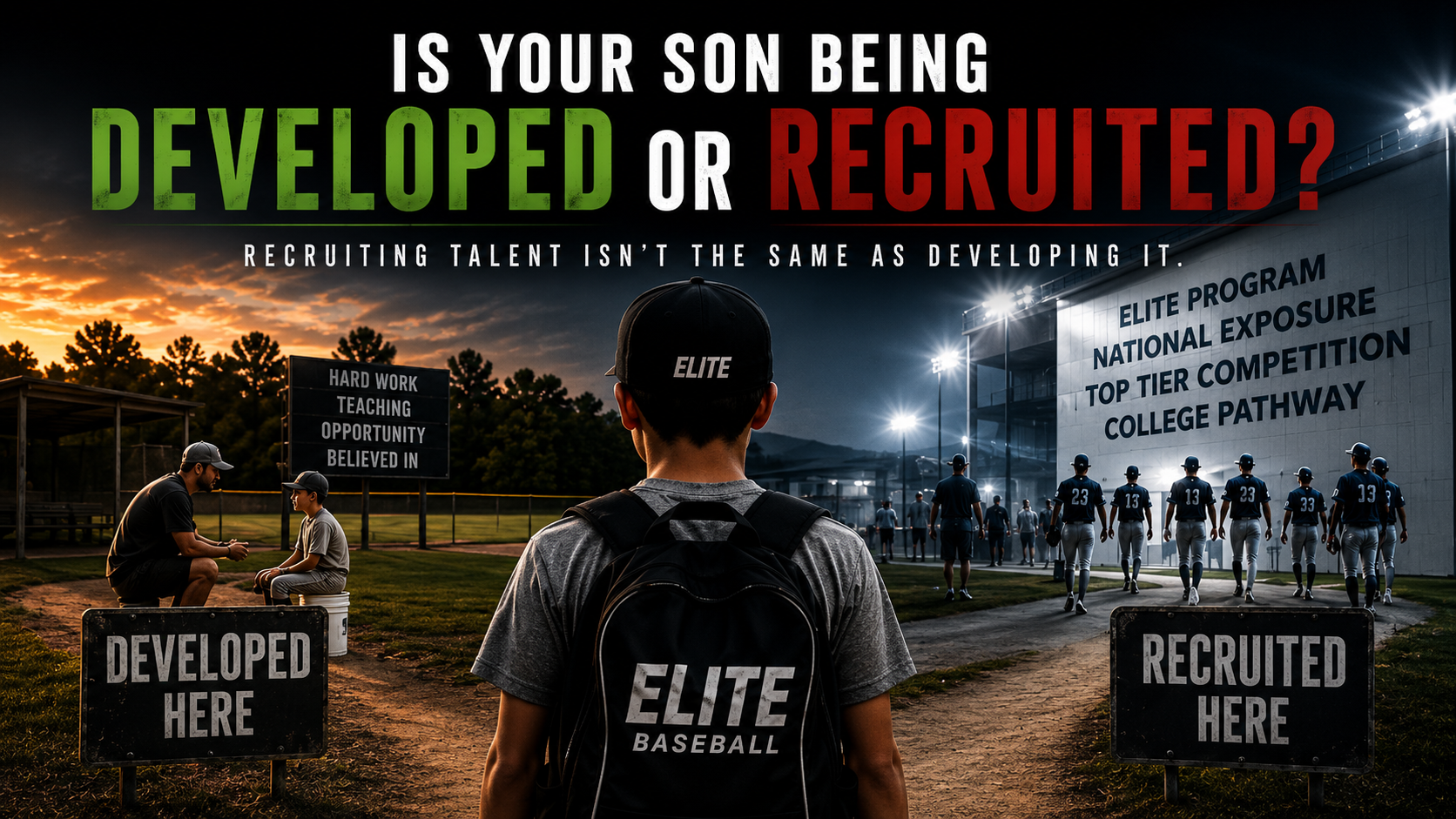
There is a trend in youth baseball that parents need to recognize.
A local team spends years developing a player.
Coaches teach him how to throw. They work through the ugly swings. They teach him where to be on a cutoff. They give him innings when he isn't dominating yet. They let him hit when he's struggling. They work with him when he's 9, 10, 11 or 12 years old — long before anybody is posting his exit velocity on social media.
Then the player gets good.
Suddenly, another organization comes calling.
And after that player joins the new organization, something interesting happens.
His talent becomes part of their marketing.
Recruiting Talent Isn't the Same as Developing It
There is nothing inherently wrong with talented players eventually moving to different teams.
Sometimes a player needs a higher level of competition. Sometimes he needs different coaching. Sometimes the local team simply isn't the right fit anymore. And families should always make the decision they believe is best for their child.
But parents should understand an important distinction:
An organization assembling talented players is not necessarily the same thing as an organization developing talented players.
If an organization recruits five outstanding 13-year-olds from five different local programs and puts them on one roster, that team may be excellent.
But ask yourself:
Where were those players when they were 9?
Who taught them to throw strikes?
Who fixed their footwork?
Who taught them how to compete?
Who gave them opportunities while they were still figuring things out?
Who worked with them before they became somebody worth recruiting?
Those answers tell you much more about player development than a tournament trophy does.
Be Careful With the Highlight Reel
Parents naturally notice successful teams.
You see the championship pictures. The rings. The rankings. The college commitments. The radar-gun numbers. The videos of players hitting balls 350 feet.
Then comes the sales pitch:
Look what our organization produces.
But did they produce those players?
Or did they collect them?
That's a question worth asking.
If an organization consistently takes average 10-year-olds and helps turn them into outstanding 14-year-olds, that's development.
If an organization consistently recruits outstanding 14-year-olds and puts them in the same uniform, that's talent acquisition.
Those are two very different things.
And a parent looking for a place where their child can actually improve should know the difference.
Your Son Isn't a Trophy for Someone's Social Media Page
There is another side of this parents should think about.
When an organization aggressively recruits your child, it feels good.
They noticed him.
They want him.
Maybe they tell you he's exactly what they're looking for. Maybe they talk about exposure, rankings, national tournaments and all the players they've sent to the next level.
But ask one uncomfortable question:
Do they want to develop my son, or do they want what my son can already do for their organization?
Because those aren't necessarily the same thing.
Your son's ability can help an organization win games.
His velocity can make their roster look impressive.
His home runs can fill their social media feed.
His accomplishments can help recruit the next family.
That doesn't automatically make the organization bad.
But it does mean you should understand the transaction.
Don't Confuse a Better Team With a Better Development Environment
This may be the biggest mistake parents make.
They assume:
Better team = better place for my child.
Not always.
A team filled with elite players can win a lot of baseball games without developing anybody.
Meanwhile, a good local coach might be taking kids who aren't finished products and actually teaching them how to play.
Development is often messy.
It includes failure.
It includes giving a kid another inning after he walks two hitters.
It includes letting him work through a slump instead of immediately replacing him with a recruited player.
It includes teaching instead of constantly upgrading the roster.
Winning and development can absolutely coexist.
But winning does not prove development.
Ask What Happens When Your Son Struggles
Almost every organization loves a player when he's performing.
The better question is what happens when he isn't.
What happens when his velocity drops?
What happens when he goes 2-for-20?
What happens when another player comes along who is a little faster, a little bigger or throws three miles per hour harder?
Does the organization continue developing your son?
Or does it start recruiting his replacement?
That's where you learn what a program actually believes.
If the organization's solution to every weakness is finding a better player somewhere else, eventually your child can become the player they're replacing.
Don't Forget the Coaches Who Helped Build Him
Youth baseball careers are full of different coaches, and players don't owe permanent loyalty to one team.
Kids grow. Circumstances change. Sometimes moving on is absolutely the right decision.
But there should still be appreciation for the people who invested in a player before there was anything in it for them.
The coach who threw thousands of batting-practice pitches.
The coach who stayed after practice.
The volunteer who fixed a kid's mechanics.
The local organization that gave him innings.
The teammates who grew alongside him.
Those years matter.
A new jersey doesn't erase them.
And when another organization showcases an accomplished player as evidence of its development program, parents should be willing to ask who actually did the developing.
Parents, Ask Better Questions
Before moving your child because a bigger organization comes calling, don't just ask where the team is ranked.
Ask:
- How many of these players have been here for several years?
- How many were recruited recently?
- What does your development program actually look like?
- What happens when a player struggles?
- How much practice and instruction happens compared with games?
- Do coaches develop the bottom half of the roster as aggressively as the top half?
- How often are players replaced by recruits?
- Can you show me players who weren't standouts when they arrived but became standouts while they were here?
That last question might be the most important one.
Don't just show me your best players. Show me your development.
Go Where Your Child Is Being Built, Not Just Displayed
There are outstanding large organizations and outstanding local programs. There are also poor examples of both.
This isn't about telling families they should never leave their hometown team.
It's about recognizing what you're actually looking at.
A roster full of talented players proves that an organization can attract talent.
It doesn't automatically prove that it can develop talent.
So when someone approaches you with the uniforms, the rankings, the national schedule and the promises of exposure, look beyond the logo.
Ask yourself:
Who is going to make my child better?
Not who has the best 13-year-olds today.
Who is going to help your 13-year-old become the best 16-year-old he can be?
Because youth baseball shouldn't be about adults collecting the best kids they can find and then taking credit for the finished product.
It should be about teaching kids, developing players and helping them become something they weren't before.
Recruiting talent can build a great team.
Developing talent builds great players.
Parents should know the difference.